Kino immer anders
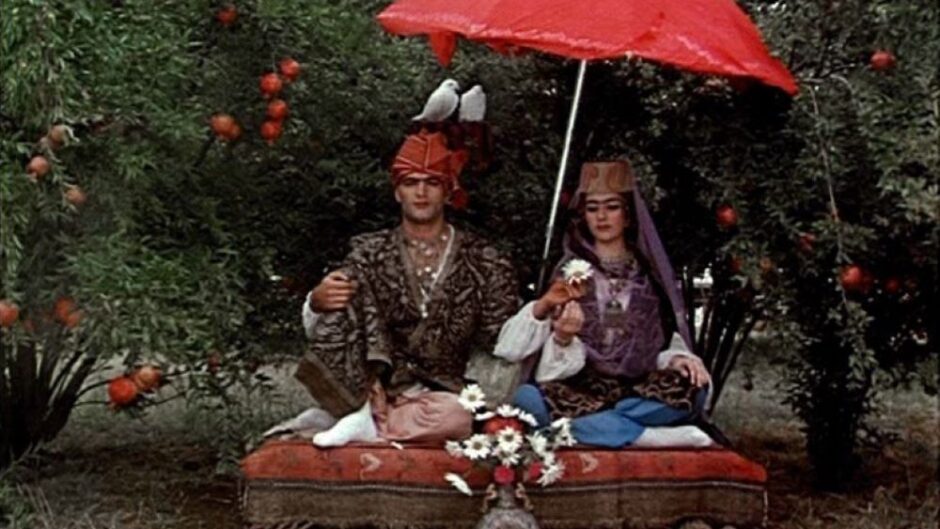
Follow the journey of Ashik Kerib, a poor minstrel who sets out on a thousand-day odyssey to win the right to marry his beloved. Devoted to the beautiful Magul-Megeri, Ashik is rejected by her wealthy father and forced to leave in search of fortune. When fate turns against him and he is declared dead, in an effort to reclaim his love, Ashik Kerib has to over come time, distance and destiny itself.
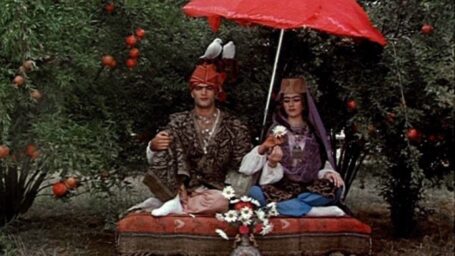
Officially designated as a children’s film, Ashik Kerib is treated by Sergei Parajanov as both a fairy tale and a cultural archive: blending storytelling with ritual, costumes, music, and iconography drawn from the Caucasus. Completely breaking with “socialist realism”, images are composed like painted tableaux, colors are saturated and symbolic, and characters move with the precision of ritual, evoking an idealized pre-Russian past. Sound and music are central. The film features Azerbaijani dialogue with Georgian “shout-over” translation, while the soundtrack moves between Muslim folk songs, Christian choral music, classical melodies, and electronic sounds.
Dedicated to Andrei Tarkovsky, Ashik Kerib stands as Parajanov’s farewell: a playful, sometimes camp celebration of fairy tale, love, and music.
Sixtine Asselot