Kino immer anders
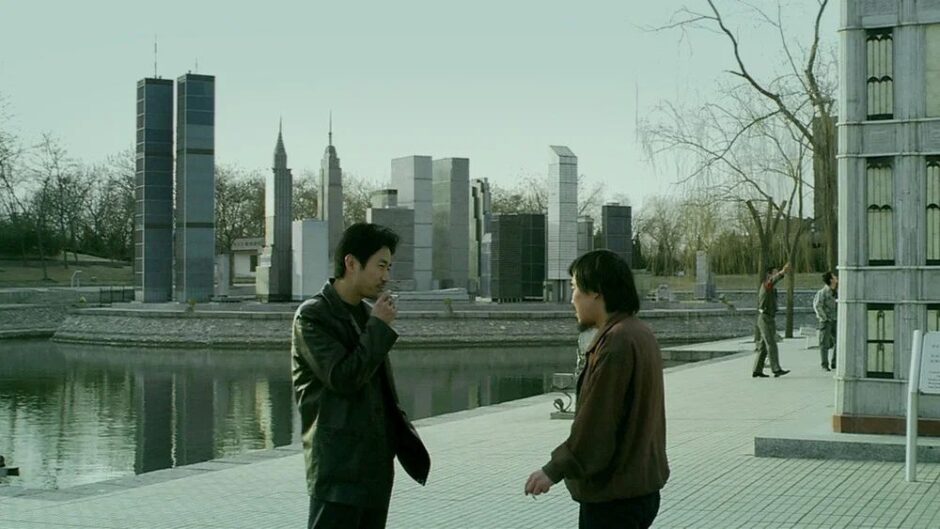
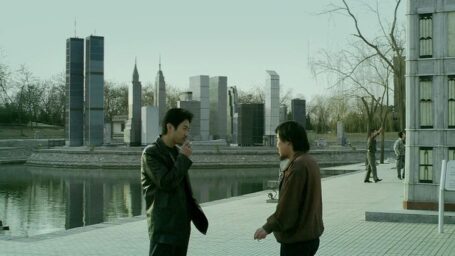
Set in Beijing in the early 2000s, the film takes place in “Beijing World Park,” a theme park filled with small models of famous places like the Eiffel Tower, the Sphinx, and the New York skyline. Tao, a worker from the countryside, works here as a dancer and is dating Taishen, the park’s head of security. On stage, wearing beautiful dresses, Tao shines under the lights. However, her tired and empty look outside of work, as she looks up at the park’s fake world betrays a deep loneliness. This stems stems from being separated from Taishen and the suffocating feeling of being trapped in a fake world, no matter how hard she works. Her sadness grows when she finds out that a Russian dancer, a colleague she had truly bonded with, has become a sex worker. But her bad luck does not end there. While attending another coworker’s wedding, Tao accidentally discovers that Taishen is having an affair with a married woman.
Throughout his career, Jia Zhangke has always focused on ordinary people who are pushed around by the rapid and massive development of China. In Beijing preparing for the Olympics and changing quickly due to globalization, these young workers from the countryside dream of the outside world but do not even have passports. It is deeply ironic that they end up working in a theme park made entirely of fake, cheap models. Halfway through the film, a young worker dies in an accident caused by working too hard; he is shown as just a small individual crushed and thrown away by the state. While The World stands out within Jia’s filmography for the sheer intensity of its cinematography, one of the most amazing moments is the long-take scene at sunset. Here, Tao talks with the young man at the construction site right before his death, while a huge airplane flies across the sky behind them. As we can clearly see in this scene, by masterfully using the depth of the screen, Jia allows two different sides of modern Chinese society to unfold simultaneously within the very same frame.
Takumi Tachibana