Kino immer anders
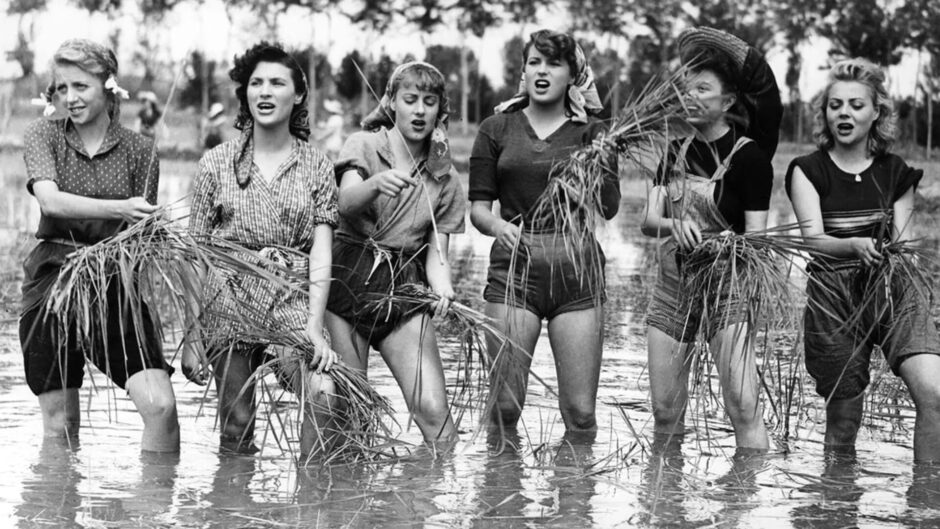
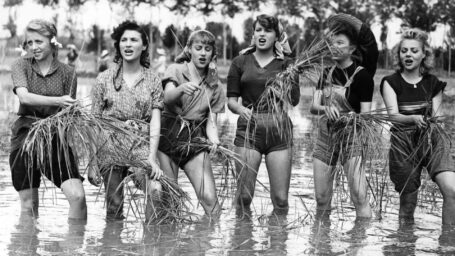
In Northern Italy, each year in May, hundreds of women gather to work the rice plains. The rice workers come from all across Italy, with all kinds of regular jobs. Among them are Francesca, a dreamer who would much rather be a dancer than a rice girl, and Silvana, who joins the rice workers spontaneously to escape the police, after her boyfriend Walter needs to hide the jewels he stole. At the barracks next to the rice fields Francesca and Silvana encounter Marco, a handsome sergeant who was stationed there with the army. We follow these characters over the 40 day long season of work, and the ensuing struggles of legality, loyalty and love.
From the very first shot of Riso Amaro – a roughly two minute long one-take covering many hundreds of extras at a train station – you can tell the perfect precision with which Giuseppe De Santis stages this overlooked Neorealist masterpiece. Entirely shot on location, the film’s magic is primarily born from its collective of women. It’s a story about the solidarity amongst these women and the men that try to come between them. This is most evident in the constant singing of the film’s first half, which culminates in a most extraordinary crowd scene, where the entire conflict is played out through a battle of song.
Christoph Bärtsch